


AI-driven protein design overcomes key limitations of IL-18–based therapies
>90% tumor suppression observed in immunotherapy-refractory models
Galux announced that it will present preclinical data on its novel immunocytokine, PD-1/IL-18v, at the American Association for Cancer Research Annual Meeting (AACR 2026).
The study highlights an IL-18-based immuno-oncology approach aimed at addressing key challenges in cancer immunotherapy, including cytokine-related systemic toxicity and the limited response seen with anti-PD-1 therapies.
“Interleukin-18 (IL-18) is a powerful cytokine capable of activating cytotoxic immune responses, but its clinical potential has been limited by systemic toxicity, neutralization by IL-18 binding protein (IL-18BP), and poor stability,” said Taeyong Park, Executive Vice President of Galux. “To overcome these barriers, we leveraged our AI platform to rationally design a novel IL-18 variant optimized for tumor-restricted activity, with the goal of maximizing anti-tumor activity while minimizing systemic effects.”
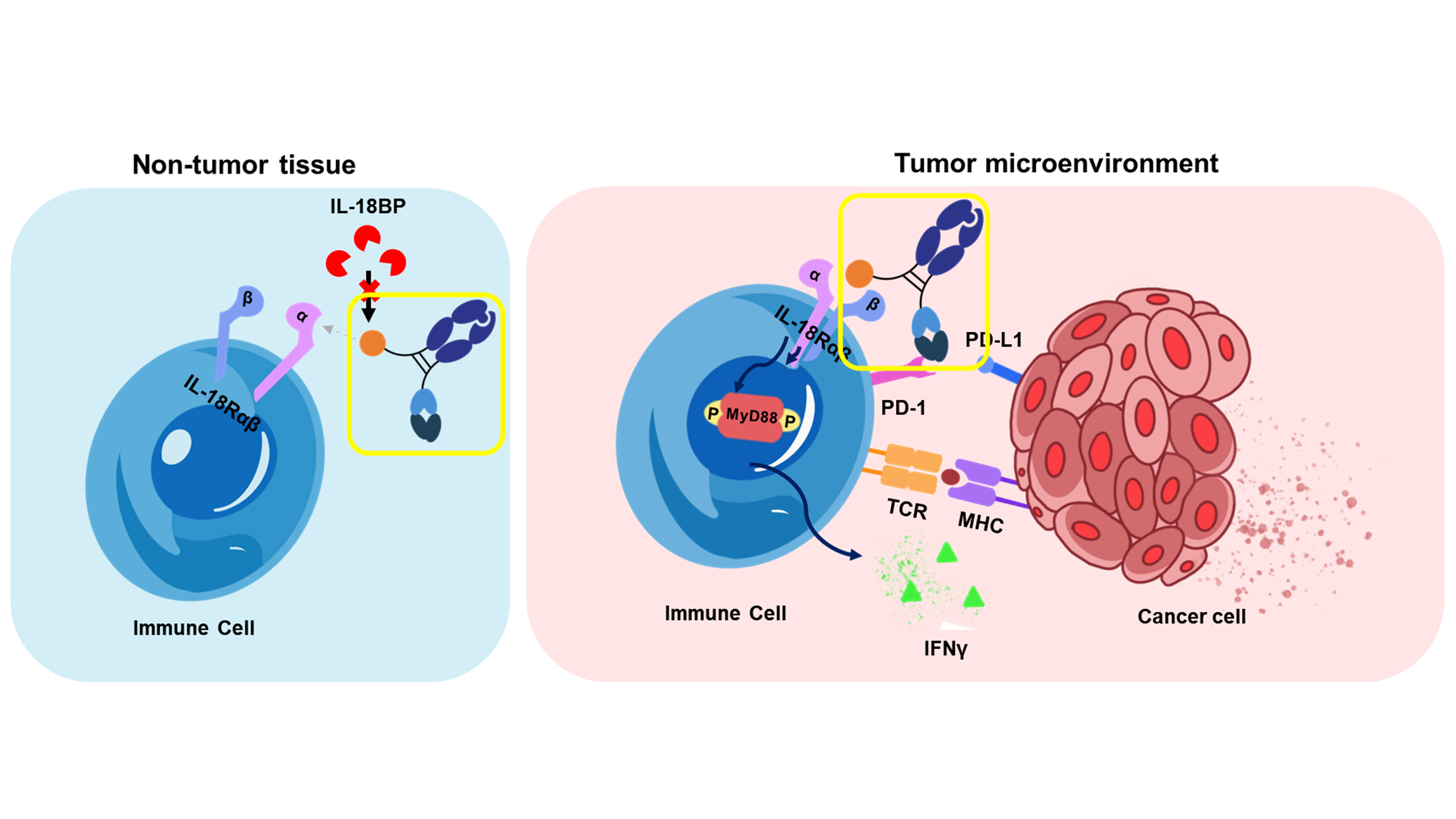
The AI-designed immunocytokine, PD-1/IL-18v, remains inactive in non-tumor tissues (left) but is selectively activated in the tumor microenvironment to induce antitumor immune responses (right).
Using its proprietary AI-driven protein design platform, GaluxDesign, the team designed a novel IL-18 variant that eliminates IL-18BP binding while substantially reducing IL-18 receptor activity. When conjugated to an anti-PD-1 antibody, however, its activity was selectively restored in PD-1–expressing immune cells, enabling tumor-specific immune activation. The resulting PD-1/IL-18v immunocytokine showed minimal signaling activity in PD-1-negative cells and over 1,000-fold higher activity in PD-1-positive cells, underscoring its highly selective, tumor-directed mechanism of action.
In vivo studies further supported the therapeutic potential of the immunocytokine, with over 90% tumor growth inhibition observed in both anti-PD-1–responsive and anti-PD-1–refractory tumor models, whereas anti-PD-1 monotherapy showed minimal efficacy. Notably, repeated dosing did not result in significant body weight loss, suggesting reduced systemic cytokine-related toxicity.
“This study demonstrates the potential of AI-driven protein design to overcome intrinsic trade-offs of natural biomolecules in therapeutic applications, allowing such constraints to be rationally modulated and enabling the simultaneous optimization of multiple properties, including efficacy, specificity, and developability,” added Park. “To effectively translate AI-driven design into therapeutic development, Galux has established an integrated dry–wet platform that seamlessly links computational design with preclinical validation. Building on this foundation, we aim to expand our differentiated pipeline of next-generation biologics powered by GaluxDesign.”
The full dataset will be presented at AACR 2026, taking place from April 17–22 in San Diego, California.
Powered by Froala Editor