


From precise de novo protein design to early-stage immunogenicity assessment
Overcoming data scarcity with a unique AI approach and best-in-class predictive performance
Galux, a pioneer in AI-driven protein design, announced the development of T-SCAPE (T-cell Immunogenicity Scoring via Cross-domain Aided Predictive Engine), an AI framework for predicting T-cell immunogenicity in therapeutic proteins. The study, conducted in collaboration with Seoul National University, has been published in the peer-reviewed journal ‘Science Advances’.
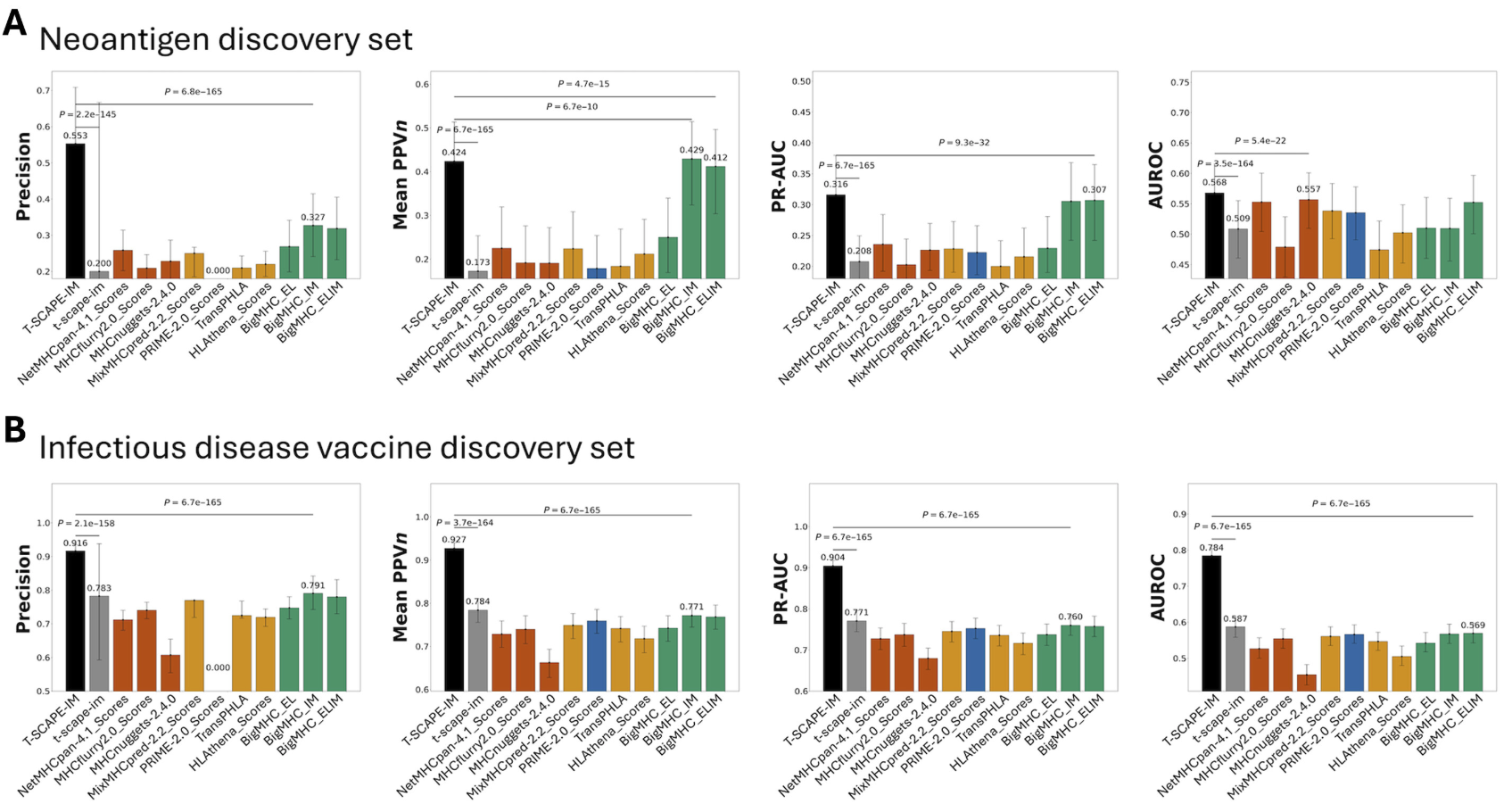
T-SCAPE (black bar) outperforms all other models in predicting immunogenic responses
T-cell activation plays a central role in immune-related safety events during drug discovery. When a therapeutic protein is recognized as foreign, T-cells can initiate responses that reduce drug efficacy or cause adverse effects. Despite its importance, predicting these responses has been difficult due to complex biological mechanisms and limited high-quality datasets.
T-SCAPE addresses these challenges by integrating diverse immunological data, including human/non-human peptide sequences, MHC binding, TCR interaction, and downstream activation assays. The model undergoes pre-training on broad biological data before being fine-tuned on curated immune-related experimental datasets, allowing it to learn underlying principles that are inaccessible through conventional single-domain frameworks.
“To overcome the critical scarcity of immunogenicity data, we employed a ‘pre-training’ strategy where the AI learns broad biological principles first,” said Dr. Jinsung Noh, who co-led the research at Galux. “By applying adversarial domain adaptation to bridge the gaps between heterogeneous biological datasets and capture common rules, we were able to dramatically enhance predictive performance.”
In evaluation studies, T-SCAPE outperformed existing approaches in predicting peptide-MHC immunogenicity. Although designed primarily for T-cell response prediction, the model could also estimate the likelihood of anti-drug antibody (ADA) formation in therapeutic antibodies, demonstrating its broad applicability across the drug discovery and development pipeline.
For Galux, the development of T-SCAPE marks an expansion of its AI protein design capabilities into drug property assessment. The company expects the technology to support internal design workflows by providing an additional layer of insight during candidate evaluation.
“This work reflects our commitment to advancing technologies that reduce uncertainty in drug discovery,” said Chaok Seok, CEO of Galux. “By combining precision design and immunogenecity assessment in a cohesive platform, we aim to support researchers prioritize superior candidates earlier and enhance efficiency throughout the drug discovery process.”
Powered by Froala Editor